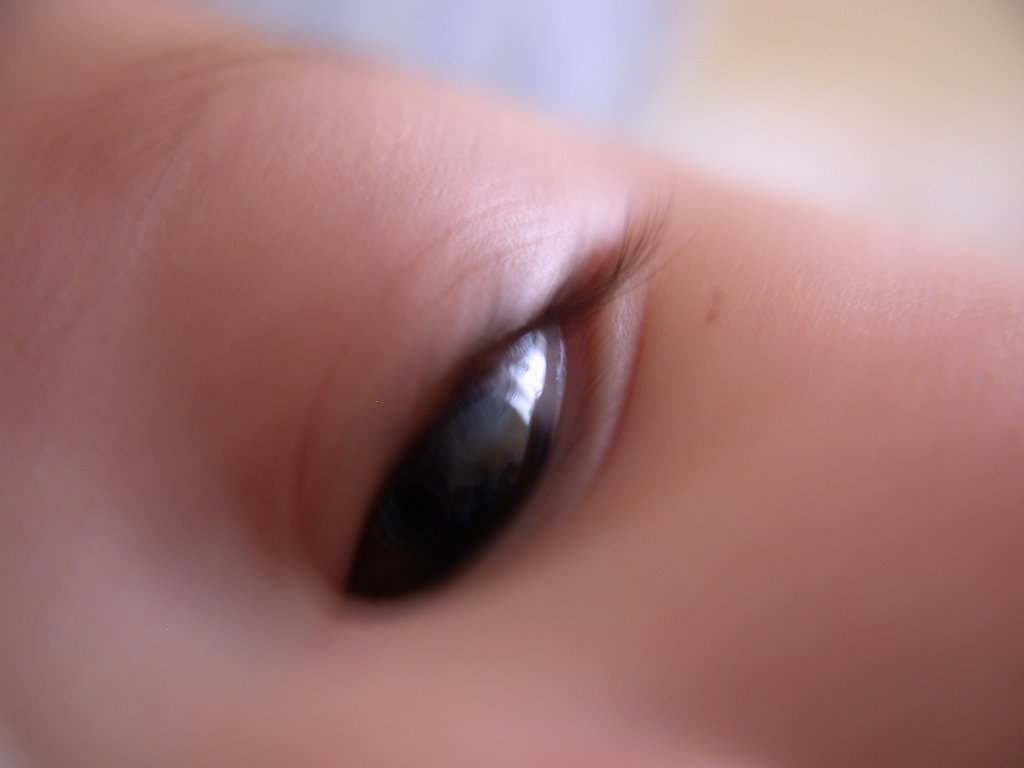
Supposedly the location of the mythological garden of the Hesperides, Atlas' daughters, was Hera's orchard in the far western corner of the world, where the immortality-giving golden apples grew.
Showing posts with label 1997. Show all posts
Showing posts with label 1997. Show all posts
Sunday, February 15, 2009
Hera Returns
Lixus was part of a chain of Phoenician- Carthaginian settlements along the northwest coast of Africa dating back to the 7th century BC. When Carthage fell to Ancient Rome, Lixus became a Roman imperial outpost.
 Supposedly the location of the mythological garden of the Hesperides, Atlas' daughters, was Hera's orchard in the far western corner of the world, where the immortality-giving golden apples grew.
Supposedly the location of the mythological garden of the Hesperides, Atlas' daughters, was Hera's orchard in the far western corner of the world, where the immortality-giving golden apples grew. 

Tuesday, December 16, 2008
Tinfou: End of the Line

We'd left Marrakesh before dawn, crossed the Tizi-n-Tichka Pass and the entire High Atlas range by late morning, and then refueled in Ourzazate by noon. The Anti Atlas and the Draa Valley were behind us by mid afternoon and soon afterwards we successfully found Garren and drove on past Zagora out to the desert, by late afternoon where we stopped, rode some camels on the dunes at sunset and slept in the courtyard of the Auberge at Tinfou. That night the milky-way flowed brightly across the sky and I felt very, very far away from my normal life and my normal world. More from a previous post here.
Saturday, December 13, 2008
Over the High Atlas

Somewhere beyond the Tizi-n-Tichka Pass on the way from Marrakesh to Ourzazate. 1997
Friday, July 07, 2006
Chefchaouen Chefchouen Chouen
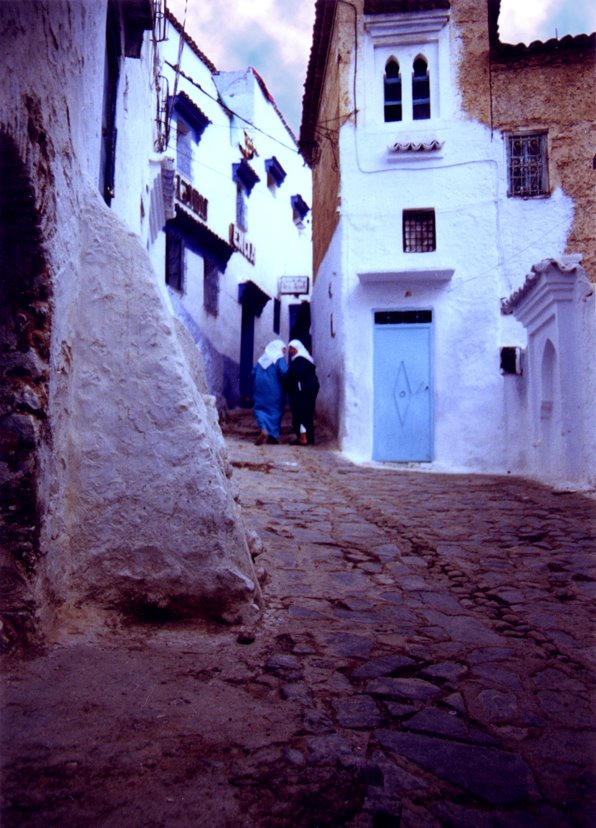 Two women walking in an alley. Sitting high in the Rif Mountains of northern Morocco, Chefchouen (also just called Chouen) is one of the most beautiful towns in Morocco and also one of the most relaxing. One reason for the laid back vibe is that this is the heart of "Kif Country" (the hashish producing area) in Morocco. It was not uncommon to see merchants and customers partaking in not just the usual hot mint tea during price negotiations but also passing around a hash pipe as well.
Thursday, July 06, 2006
Tamezmoute? Or Not Tamezmoute? That is the question.
 We left Marrakesh early in the morning and headed south east over the the Atlas Mountains. We were looking for a Peace Corps Volunteer named Garren who was living in a village 11 hours away near the Draa Valley. A friend had arranged for us to meet up and head out to the desert together. I had never met Garren before and the directions he had written down for my friend a couple of weeks earlier went something like this: "Go for a few hours past Ourzazate until you cross the river three times, then go past three villages. Ask for me at the cafe of the fourth village." Sounds simple until you cross the first few bridges over dry river beds and wonder "did those count as rivers?" or past a few houses or buildings along the side of the road and try to figure out if they were considered a village or just some houses.
So after hours of wondering if we had traveled far enough or gone way too far and pretty much giving up on finding him altogether, we drove through a sleepy, dusty, sun baked little village and heard something unusual. Almost everywhere I had been in Morocco the default musical soundtrack usually consisted of a mix of Moroccan pop music, Algerian Rai Music, Berber folk tunes, or even Adalusian Flamenco guitar which could be heard wafting from cafes, taxis, street vendors, and buses. But here was a different type of sound, both strikingly out of place and yet very much at home at the same time. Filling the air of this seemingly deserted little village was a music that sounded at first to have little form but slowly coalesced into something very familiar to me.
The unmistakable little voice, and the oddly beautiful sounds of Jerry Garcia and the Grateful Dead's "Here Comes Sunshine" rolled down from a cafe with a shade arbor under which sat a light-skinned, bearded man sipping tea and talking with a berber man. We had found Garren.
We relaxed for a while sipping tea and just absorbing the setting before Garren joined us on our trek to the desert, beyond Zagora, where we ended up in Tinfou and spent the night sleeping in the courtyard of the Auberge du Repos de Sables.
After our adventure in the desert together we brought Garren back to Tamezmoute where it happened to be the day of the weekly market. We walked with him as he did his shopping for the week.
View Larger Map
We left Marrakesh early in the morning and headed south east over the the Atlas Mountains. We were looking for a Peace Corps Volunteer named Garren who was living in a village 11 hours away near the Draa Valley. A friend had arranged for us to meet up and head out to the desert together. I had never met Garren before and the directions he had written down for my friend a couple of weeks earlier went something like this: "Go for a few hours past Ourzazate until you cross the river three times, then go past three villages. Ask for me at the cafe of the fourth village." Sounds simple until you cross the first few bridges over dry river beds and wonder "did those count as rivers?" or past a few houses or buildings along the side of the road and try to figure out if they were considered a village or just some houses.
So after hours of wondering if we had traveled far enough or gone way too far and pretty much giving up on finding him altogether, we drove through a sleepy, dusty, sun baked little village and heard something unusual. Almost everywhere I had been in Morocco the default musical soundtrack usually consisted of a mix of Moroccan pop music, Algerian Rai Music, Berber folk tunes, or even Adalusian Flamenco guitar which could be heard wafting from cafes, taxis, street vendors, and buses. But here was a different type of sound, both strikingly out of place and yet very much at home at the same time. Filling the air of this seemingly deserted little village was a music that sounded at first to have little form but slowly coalesced into something very familiar to me.
The unmistakable little voice, and the oddly beautiful sounds of Jerry Garcia and the Grateful Dead's "Here Comes Sunshine" rolled down from a cafe with a shade arbor under which sat a light-skinned, bearded man sipping tea and talking with a berber man. We had found Garren.
We relaxed for a while sipping tea and just absorbing the setting before Garren joined us on our trek to the desert, beyond Zagora, where we ended up in Tinfou and spent the night sleeping in the courtyard of the Auberge du Repos de Sables.
After our adventure in the desert together we brought Garren back to Tamezmoute where it happened to be the day of the weekly market. We walked with him as he did his shopping for the week.
View Larger Map
Sunday, February 19, 2006
Qarawiyin Mosque in the Medina of Fez
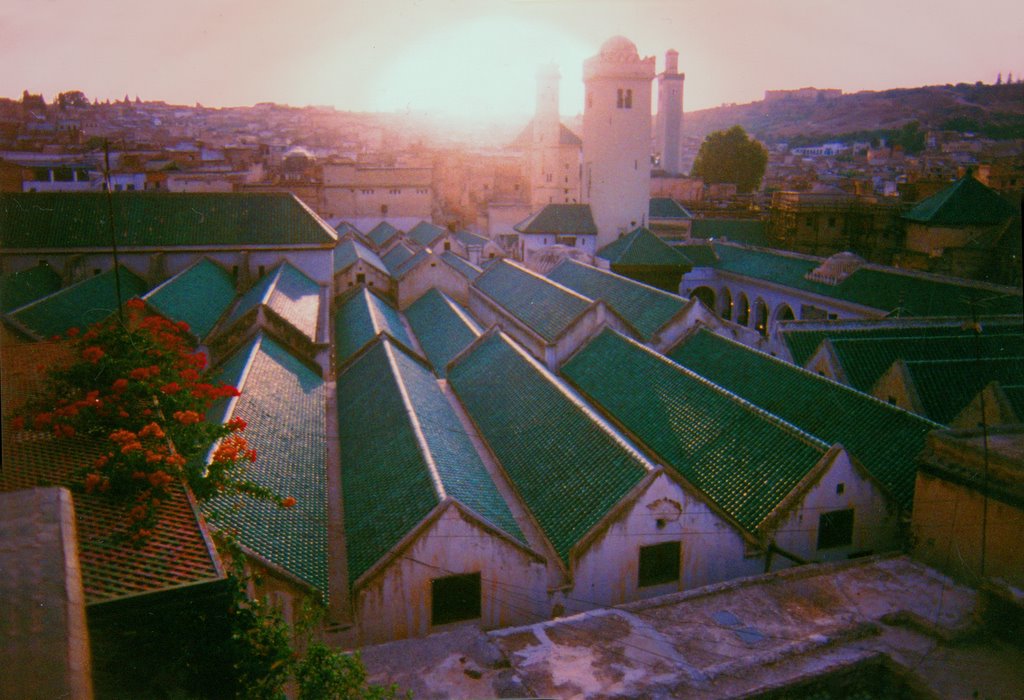 Looking out from above the thousand year old medina of Fez, Morocco in 1997, the green tiles on the roof of the Qarawiyin Mosque glitter in the setting sun. It is debateably the oldest university in the word and according to Wikipedia Gerbert of Auvergne (930-1003), who became Pope Sylvester II and who supposedly introduced the use of zero and Arabic numerals to Europe, was an alumni of al-Qarawiyyin.
 The medina is a maze of twisting alleys and covered walkways that make navigation a real challenge. The carpet shop that served tea on it's rooftop terrace, where this photo was taken, had closed due to a fire when I went back in 2000, hopefully it will reopen.
Subscribe to:
Posts (Atom)